PSTN & ISDN

PSTN & ISDN
Switch-off

Discover how the 2027 PSTN and ISDN switch-off will impact your business. Learn what steps to take now to future-proof your communications and stay connected.

Skyscrapers.

What you need to look for?

The switch off will effect businesses and organisations in many ways.

We recommend you have a look at your bill to see if any of the below are in use: ISDN30, ISDN30e, ISDN2, Analogue Line, Business Line, PSTN Line

These could be used for: Alarm lines, Lift lines, PDQ/EPOS lines, Fax, Modem, Powerfail, Telephone systems

If you have an on-site PBX, telephone line, fax line, PDQ line or broadband line, you will be affected and need to make a plan to switch over.

Discuss your PSTN & ISDN arrangements with our team

Just submit your details and we’ll be in touch shortly.

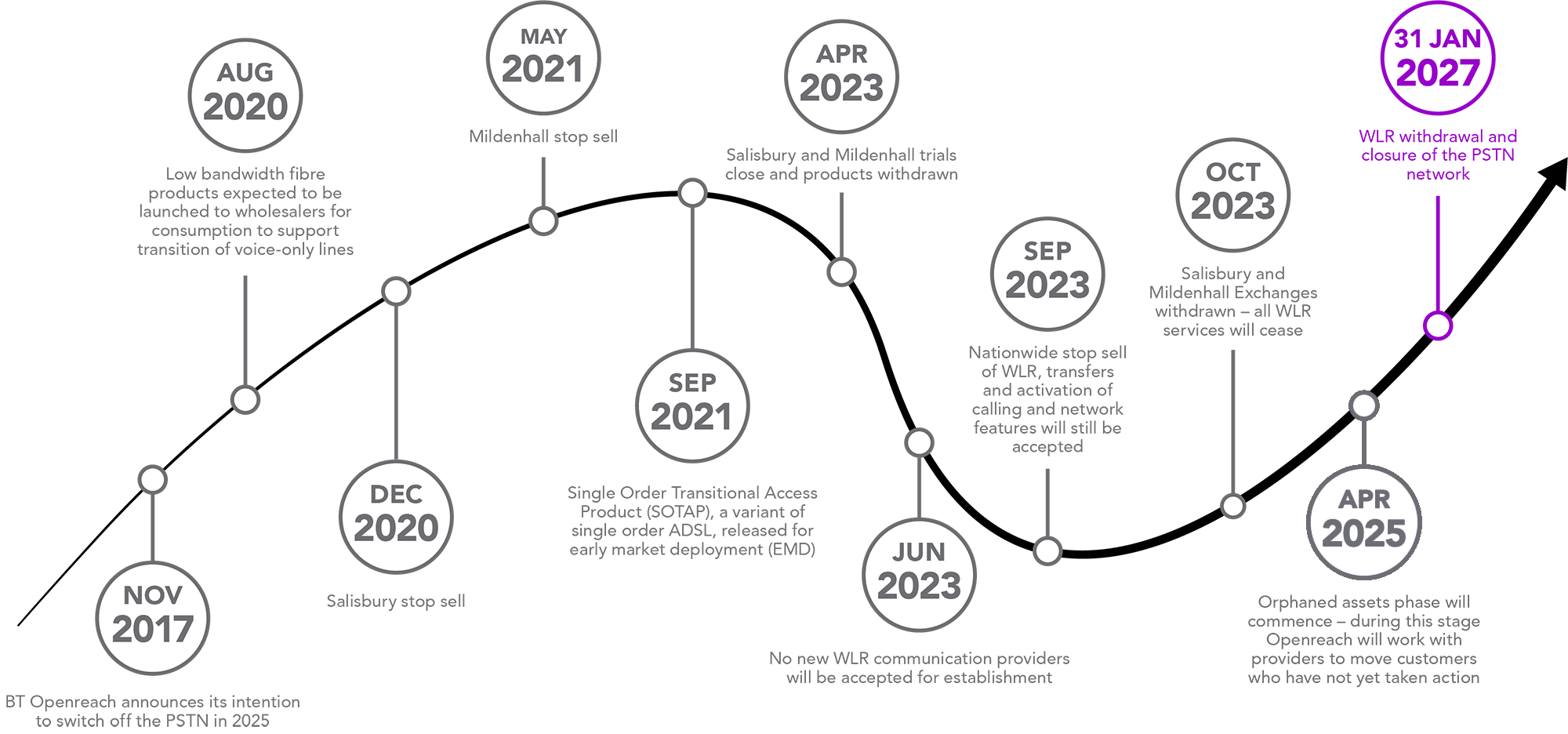
pstn-timeline
pstn-game

PSTN Switch-off 2027 game

Prove it to yourself (or set your mind at rest) in just 90 seconds...

Our interactive game lets you test your awareness (and your potential readiness) with a whistle-stop tour of a modern business environment. Can you identify all the systems and devices that will stop working when the PSTN waves goodbye? Spoiler: it’s harder than most players think.

Upgrading the Access Network

BT & Openreach’s decision to switch off the Public Switched Telephone Network (PSTN) & Integrated Services Digital Network (ISDN) is mainly due to both technologies becoming out of date and expensive to operate and maintain.

Openreach plans to invest more into modern-day technology and hence focusing instead on deploying fibre infrastructure and future-proofing their network across the UK.

Any individual or organisation still using these traditional voice services will need to have moved to newer SIP and IP voice solutions in the near future. If not, then they simply won’t be able to use their phones or any service that is being delivered using a PSTN.

WLR_Page_1
WLR_Page_2

No more dial tone; alternatives?

SIP and VoIP

The terms SIP and VoIP refer to telephony based services delivered using Internet Protocol (IP) signalling.

What is SIP?

SIP services are generally used to connect lines to a telephone system and these are a direct replacement for the ISDN technology.

It is designed to support real-time multimedia sessions between groups of participants. In addition to telephone calls, SIP can also be used to set up video and audio multicast meetings, or instant messaging conferences.

What is VoIP?

This is a general term used to describe routing voice calls over an IP network.

The term is closely associated with hosted telephones, where a telephone system installed at a customer’s premises is replaced with a central system shared between many different locations.

Flexible VOIP telephony systems can be delivered fully hosted in the Cloud, on-premise or a combination of both (hybrid).

They are easy to manage and incorporate a number of features including instant chat, video conferencing, screen sharing and phone calls through mobile apps.

Don’t panic; be prepared

Engage with an industry professional to better understand your options.

  • Wavenet has been delivering PSTN & ISDN services since 2003 and has years of experience providing communication solutions to business and organisations.

  • Our latest range including SIP and VoIP solutions, refining our portfolio to best match out customers’ requirements.

  • We have already developed a number of IP and VoIP services, replacing current PSTN and ISDN services for many clients, and would be happy to discuss the benefits of these over your current solution.

  • We’re offering both new and existing customers alike the opportunity for a free telephony audit.

  • This audit will review all of the telephony services currently supplied to your business, providing a report on the services and a recommendation of the actions needed to prepare for the withdrawal of the copper network in 2027.

WLR_Page_3

Glossary

PSTN: The Public Switch Telephone Network, was introduced in the 1800 and is a circuit-switched analogue telephone system that enables the transmission of voice and data (broadband) through a network of copper wires. This system is also referred to as landlines, Plain Old Telephone Service (POTS) or fixed-line.

PSTN is used by residential and business customers.

ISDN: Integrated Services Digital Network (ISDN) allows for simultaneous digital transmission of voice, video and data services over the traditional PSTN copper network. This is mainly used by businesses to support multiple users to make & receive calls at the same time, over the same link, using different channels to keep the traffic separate.

ISDN comes in a number of options:

ISDN2: Mainly used by small businesses. With ISDN2e you can connect up to 60 channels. Channels are sold in pairs and can be bonded to increase bandwidth for things like video conferencing.

ISDN30: This is designed for businesses that need high-quality video conferencing, consistent transfer of large data files, or that operate call centres.

Each connection provides 8-30 independent 64k channels. You can combine these for bandwidth intensive applications such as high-quality video conferencing or large data file transfers.

ISDN30e: This is the same as ISDN30 but with some additional features like Customer controlled Call Forwarding and Call Deflection.

WLR: Wholesale Line Rental (WLR) allows alternative suppliers to rent access lines on wholesale terms from Openreach, and resell the lines to customers, providing a single bill that covers both line rental and telephone calls.

PSTN Switch-off resources

All resources
There's more to the PSTN switch-off than meets the eye

There's more to the PSTN switch-off than meets the eye The impending PSTN (Public Switched Telephone Network) switch-off isn’t just about replacing traditional lines. It’s a seismic shift that impacts far more than most realise – and if you’re not prepared, it could cost your business dearly. Most companies are aware that traditional analogue lines and ISDN systems for calls and broadband are being phased out by January 2027. But what many don’t see is the vast ripple effect of this transition – touching everything from lifts to life-critical systems, cash machines, and even traffic lights. What does the PSTN switch-off mean in simple terms? When it comes to the PSTN switch-off, it’s easy to think that it is just about phone lines. But the truth is, it’s much more complex. Here is what’s at stake: Life-saving systems: fire alarms, major medical and safety devices, emergency alarms in care homes, emergency pendants, telemetry services monitoring boiler rooms, dams, sluice gates, and substations. Public infrastructure: traffic lights, bus stops, speed cameras, and traffic management systems. Business-critical devices: PDQ and payment terminals, ATMS, CCTV, video surveillance, door entry, security systems, and remote access points. Transport & emergency services: roadside AA/RAC recovery alerts and devices, and emergency phone lines in hazardous environments. Telecommunications & internet: leased lines, private networking facilities, dial-up lines, broadband DSL services, and international leased lines. Community & public services: emergency teams and vehicles, payphones, modems, industrial control, public alerts, and more. If every one of these vital systems suddenly loses connectivity – chaos, downtime, and danger could follow. The possible business impact of the PSTN switch-off could be financial losses, public safety risks and erosion of customer trust. The PSTN switch-off is a vital business resilience issue – the time to act is now Unlike many providers who may focus on the obvious, we see what others miss. Our team dives beneath the surface, examining your entire network ecosystem to identify what’s at risk when the PSTN switches off. We have mapped out the hidden web of critical systems that rely on legacy infrastructure – and yes, we’ve prepared solutions for each one. Check out our iceberg infographic to see a quick glance of the PSTN switch-off picture. The switch-off is just the tip of the iceberg. Without planning, your operations could face catastrophic disruption. Don’t let your business be caught unaware. Reach out today for an in-depth assessment, and explore solutions tailored to your critical systems. Because when it comes to the PSTN switch-off, we see beyond the iceberg – and help your business stay afloat.

Read more
Placeholder thumbnail
What is the WLR switch-off?

The WLR switch-off roadmap The countdown has begun – are you prepared? The WLF (Wholesale Line Rental) switch-off is already underway, and by January 2027, all traditional PSTN and ISDN lines will be switched off. Doing nothing isn’t an option anymore. Without action, your vital communications could face disruption, affecting your business operations and customer service. Why act now for the WLR switch-off? This isn’t just a technical upgrade – it’s a chance to transform your communication infrastructure into a reliable, feature-rich, all-IP network. Moving to an all-IP network unlocks better reliability, feature-rich communication, and future-proof capabilities that keep your business connected and competitive in a digital-first world. Your WLR switch-off migration journey starts here Switching to an all-IP solution is easier than you think. We help you assess your current setup and craft a tailored plan for a smooth, seamless migration. Options include: FTTP & SOGEA: Super-fast dedicated internet for unbeatable connectivity IP Voice & Hosted Voice: Flexible, scalable telephony solutions for modern communication UC Applications: Boost collaboration across your team, anywhere, anytime SIP Trunking: Cost-effective, reliable connectivity that scales with your needs Future-proof your business today Migrating early minimises disruption and unlocks new operational efficiencies. An all-IP network offers smoother communication, advanced features, and easier management, so you stay ahead in today’s digital economy. Be prepared for the WLR switch-off Ready to make the switch? We’ve got the perfect resource to help you stay ahead: our visual quick guide on the Openreach switch-off schedule. It’s a simple, clear, and easy-to-follow overview that helps you understand the timeline and plan your migration effectively. Download the WLR Switch-off Guide now and get your WLR migration plan on track. Be proactive and secure your business’s future communications today! Visit wavenet.co.uk/pstn-switch-off for more information.

Read more
Voice Partners
BT logo
Gamma
8x8_logo_2016.svg
Wildix
Partner_Logo_Mitel_grey
Connectivity
Virgin Logo
TalkTalk Business Logo
sky
BT logo
City Fibre Green

Contact us now to discuss how we can help you along this journey